An Chluain Mhór / The Big Meadow is a great place for a walk along the Athlone Canal where you can aldo fish in Athlone, Co. Westmeath.
Vocabulary:
cluain [f] = meadow mór [adj] = big, great an chluain mhór = the big meadow
Grammar:
1) The definite article “an” lenites initial b, c, f, g, m, p and prefixes with -t initial s followed by a vowel or l, n, r of the singular feminine nouns in nominative. 2) The initial b, c, f, g, m, p of attributive adjectives following singular feminine nouns in nominative are lenited.
Note:
In the light of the above rules, there is an error on that road sign. The attributive adjective “mór” should be lenited after the feminine noun “cluain”.
Ascal Shruthán an Mhuilinn agus Céide na gCéadras / Millbrook Avenue & Cedarwood Drive
Vocabulary:
ascaill [f] = armpit; recess; (in street names, often spelled “ascal”) avenue
sruthán [m] = stream, brook muileann [m] = mill, grinder; manufactory sruthán an mhuilinn = a stream of the mill
agus = and
céide [m] = flat-topped hill; (in street names) drive céadras [m] = cedar céide na gcéadras = a flat-topped hill of the cedars Céide na gCéadras = Cedar Drive
Grammar:
Three errors in one road sign. Two Irish and one English: 1) The word “an mhuilinn” (singular genitive of “muileann” = mill) is spelled incorrectly with double “l”. There are two similar words which can be easily mixed up – “muileann” (mill) and “muillean” (mullion). 2) The word “céide” is spelled without a “síneadh fada” (long accent). The accent is very important in Irish language as it can change a meaning of the word – fear (man) / féar (grass) or seo (this) / seó (show). 3) The word “cedarwood” is spelled with an unwanted “a”. The word was probably mixed up with the Irish “céadras” (cedar).
Feirm Ghleann na bhFianna / Glendeer Pet Farm is a pet farm west of Athlone where children can spend great time with nature.
Vocabulary:
feirm [f] = farm
gleann [m] = glen fia [m] = deer; wilderness gleann na bhfianna = a glen of the deer
Grammar:
The plural of nouns is formed using a variety of ways (suffixes and/or root changes). There are some rules on the formation of the plurals but it is the best to learn plural forms of nouns together with their genitive forms.
1) Palatalisation of masculine noun roots cat [m] > cait leabhar [m] > leabhair
2) Palatalisation and change of masculine noun roots éan [m] > éin fear [m] > fir
3) Palatalisation of masculine noun roots and replacing the ending -ch with -gh Éireanach [m] > Éireanaigh
4) Replacing the ending -ch of masculine nouns with the suffix -í bealach [m] > bealaí
5) Adding the suffix -a to feminine nouns ending with -c, -ch, -óg, -eog, -lann muc [f] > muca gealach [f] > gealacha bróg [f] > bróga fuinneog [f] > fuinneoga leabharlann [f] > leabharlanna
6) Adding the suffix -e to feminine nouns ending with slender consonants súil [f] > súile
7) Adding the suffix -í to masculine nouns ending with -a, -ín and to professions ending with -oir, -óir, -úir madra [m] > madraí sicín [m] > sicíní feirmeoir [m] > feirmeoirí innealtóir [m] > innealtóirí dochtúir [m] > dochtúirí
8) Adding the suffix -í to feminine nouns oifig [f] > oifigí
9) Adding the suffix -aí to masculine nouns rud [m] > rudaí
10) Adding the suffix -ta to feminine and masculine nouns ending with broad consonants scéal [m] (story, piece of news) > scéalta grian [f] > grianta
11) Depalatalisation and adding the suffix -ta to feminine nouns ending with slender consonants bliain [f] > blianta
12) Adding the suffix -anta oíche [f] > oícheanta
13) Adding the suffix -cha, -acha, -eacha teanga [m] > teangacha cineál [m] > cineálacha maidin [f] > maidineacha
14) Adding the suffix -nna, -anna, -eanna fia [m] > fianna bás [m] > básanna scoil [f] > scoileanna
15) Adding the suffix -the to nouns ending with -í dlí [m] > dlíthe
17) Replacing the ending -e with the suffix -te léine [f] > léinte baile [m] (home, town) > bailte
16) Replacing the ending -e with the suffix -í ailse [f] > ailsí bríste [m] > brístí
18) Replacing the ending -í with the suffix -ithe ainmhí [m] > ainmhithe
19) Replacing the ending -ú with the suffix -uithe, -the scrúdú [m] > scrúduithe síniú [m] > sínithe
20) Irregular plurals bean [f] > mná duine [m] > daoine lá [m] > laetheanta muir [f] > mara tír [f] > tíortha teach [m] > tithe bó [f] > ba caora [f] > caoirigh doras [m] > doirse mac [m] > mic
And probably several more. Also the fact that there are differences between Irish dialects – áit [f] (place) > áiteacha in Connacht and áiteanna everywhere else – adds to this complexity.
The word “rampa” is obviously a loanword (“béarlachas” = “anglicism”) from the English word “ramp” even though there is a beautiful Irish word “uchtóg” (small heap, rise in ground, bump on a road). More and more English loanwords displace native Irish words:
carr vs gluaisteán = car fón vs guthán = phone aicsean vs gníomh = action zú vs gairdín ainimhithe = zoo ceamara vs grianghrafán = camera bataire vs ceallra = battery cuirtín vs brat fuinneioge = curtain treabhsar vs bríste = trousers murdar vs dúnmharú = murder músaem vs iarsmalann = museum mapa vs léarscáil = map héileacaptar vs ingearán = helicopter sásar vs fochupán = saucer
meathán buí = a yellow meadow dolmain mheatháin bhuí = a dolmen of a yellow meadow
Grammar:
Very often feminine nouns end in slender consonant and masculine with broad consonant, like “dolmain” is feminine and “meathán” is masculine, but beware there are plenty of exceptions.
Slender consonants are consonants surrounded by slender vowels “e” and “i” and broad consonants are surrounded by broad vowels “a”, “o” and “u”.
Plural genitive: arda (nouns with strong plurals) ard (nouns with weak plurals)
A weak plural is formed by adding the suffix -a or by a palatalisation of a noun root. A strong plural is formed by adding one of the suffixes -í, -acha, -anna or -tha.
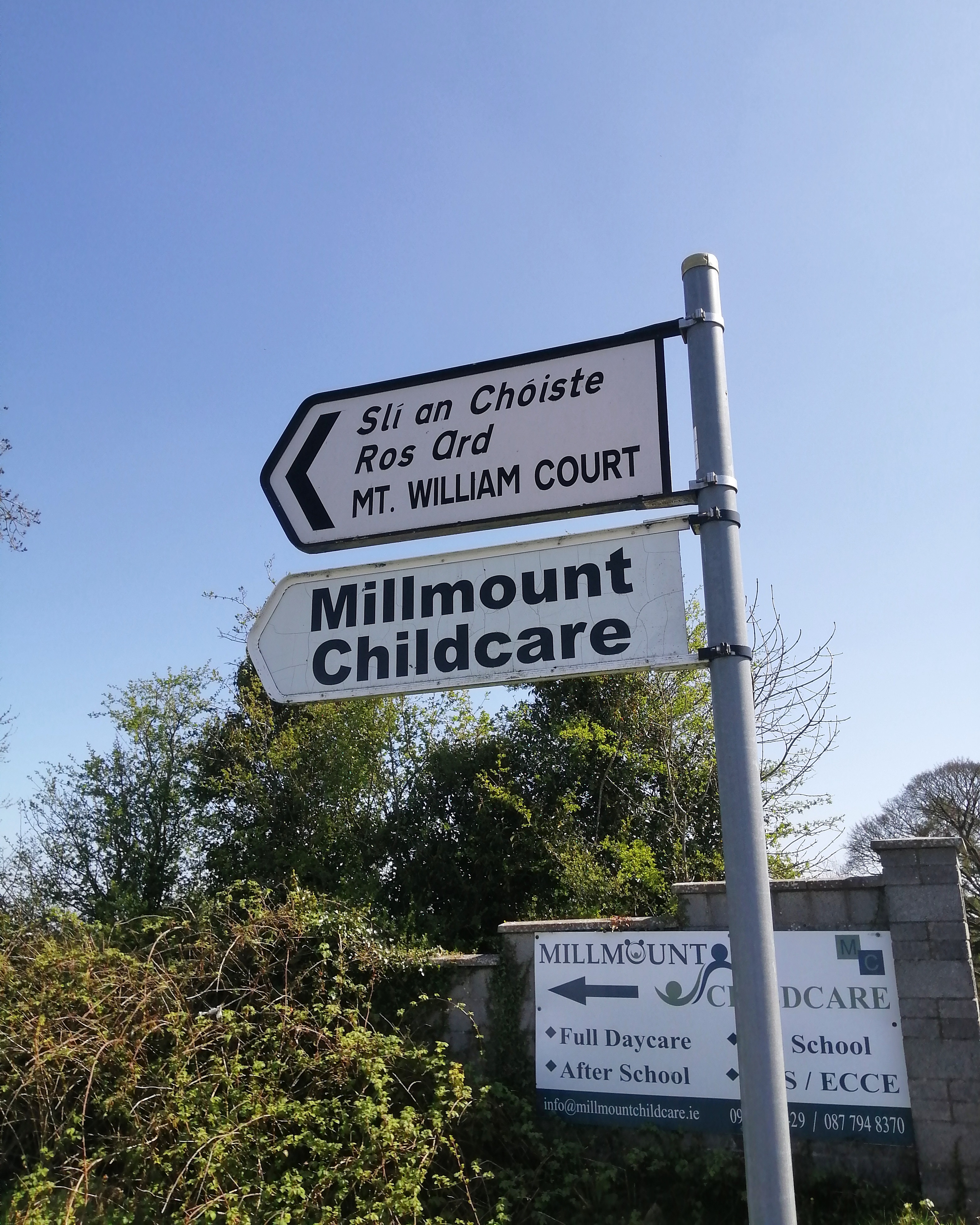
The noun “ros” is masculine with a weak plural.
ros ard = a high wood rois aird = of a high wood rois arda = high woods ros ard = of high woods




 Learn Irish from the Road Signs