Bus Éireann

Bus Éireann is a national bus opeartor of Ireland

Vocabulary:
bus = bus
Éire = Ireland
stop = stop
bus Éireann = a bus of Ireland

Grammar:
Only a few Irish nouns retained their dative case forms in singular. One of them is “Éire”.

nominative: Éire
genitive: Éireann
dative: Éirinn (in Éirinn = in Ireland)

Other examples:

nominative / genitive / dative
fiche (twenty, score) / fichead / fichid (ceithre fichid = four score, eighty)
ceann (head) / cinn / cionn (os cionn = over the head, above)
teach (house) / tí / tigh (tigh Mhicheáil = in Michael’s house)

Note:
This time the Irish name of the town Monksland is spelled correctly “Fearann na Manach”. In my second post I showed a road sign with a misspelled name of the town where “manach” (monk) contains a double “nn”.

#language #teanga #roadsigns #roadsign #road #sign #ireland #eire #irish #irishlanguage #gaeilge #anghaeilge #irishwords #focailghaeilge #words #focail #grammar #gramadach #irishgrammar #gramadachgaeilge #learnirishfromroadsigns #foghlaimgaeilgeochomharthaibothair

Ionad Oidhreachta an Droma / Drum Heritage Centre

Ionad Oidhreachta an Droma / Drum Heritage Centre

Vocabulary:
ionad = place, site; unit
oidhreacht = inheritance; heritage
An Droim = Drum
ionad oidhreachta an Droma (literally: a place of heritage of Drum) = Drum Heritage Centre

mion- = minor-, mini-
samhail = likeness; image, model
obair = work
mionsamhail = miniature, model
mionsamhail oibre (literally: model of work) = working model

muileann = mill; manufactory
arbhar = corn, cereals
meánaoiseach = Medieval
faoi = about; under
tiomáint = driving
uisce = water
muileann arbhair = a corn mill
muileann arbhair meánaoiseach = a Medieval corn mill
faoi thiomáint uisce (literally: under driving of water) = driven by water
muileann arbhair meánaoiseach faoi thiomáint uisce = a Medieval water driven corn mill

#language #teanga #roadsigns #roadsign #road #sign #ireland #eire #irish #irishlanguage #gaeilge #anghaeilge #irishwords #focailghaeilge #words #focail #grammar #gramadach #irishgrammar #gramadachgaeilge #learnirishfromroadsigns #foghlaimgaeilgeochomharthaibothair

Baile Daighean / Ballydangan

Baile Daighean / Ballydangan is a township in Co. Roscommon

Vocabulary:
baile = town; home
daingean (variant: daighean) [m] = fortress, strongfold; [adj] = fortified, strong
baile daingean (baile daighean) = a fortified town

#language #teanga #roadsigns #roadsign #road #sign #ireland #eire #irish #irishlanguage #gaeilge #anghaeilge #irishwords #focailghaeilge #words #focail #grammar #gramadach #irishgrammar #gramadachgaeilge #learnirishfromroadsigns #foghlaimgaeilgeochomharthaibothair

An Droim / Drum

An Droim / Drum is a small village with several historical and religious sites, including Drum Cemetery, St. Brigid’s Church and Drum Monastic Site located in south County Roscommon

Vocabulary:
droim = ridge; back
an droim = the ridge; the back

#language #teanga #roadsigns #roadsign #road #sign #ireland #eire #irish #irishlanguage #gaeilge #anghaeilge #irishwords #focailghaeilge #words #focail #grammar #gramadach #irishgrammar #gramadachgaeilge #learnirishfromroadsigns #foghlaimgaeilgeochomharthaibothair

Béal Átha na Sluaighe / Ballinasloe

Béal Átha na Sluaighe / Ballinasloe is one ow the largest towns in Co. Galway

Vocabulary:
béal = mouth, lip
áth = ford
slua (old spelling: sluagh) [m] = crowd, multitude; army

Grammar:
slua / an slua = a crowd / the crowd
slua / an tslua = of a crowd / of the crowd
sluaite / na sluaite = crowds / the crowds
sluaite / na sluaite = of crowds / of the crowds

Etymology:
slua (Modern Irish, new spelling) < sluagh (Modern Irish, old spelling) < slúagh (Middle Irish) < slúag, slóg (Old Irish) < *slougos (Proto-Celtic) = troops, army < *slowgos, *slowghos (Proto-Indo-European) = entourage

Cognates in other Celtic languages:
sluagh (Scottish) = crowd, multitude
llu (Welsh) = throng, multitude

Cognates in other languages:
sługa (Polish) = servant
sluha (Czech, Slovak) = servant
слуга (Russian, Ukrainian) = servant
slugă (Romanian) = servant

#language #teanga #roadsigns #roadsign #road #sign #ireland #eire #irish #irishlanguage #gaeilge #anghaeilge #irishwords #focailghaeilge #words #focail #grammar #gramadach #irishgrammar #gramadachgaeilge #learnirishfromroadsigns #foghlaimgaeilgeochomharthaibothair

Gach Treo / All Routes

Gach Treo / All Routes

Vocabulary:
gach = every, each
treo = direction, way
gach treo = every direction

gach duine = everybody
gach rud = everything
gach áit = everywhere
gach ala = every now and then

#language #teanga #roadsigns #roadsign #road #sign #ireland #eire #irish #irishlanguage #gaeilge #anghaeilge #irishwords #focailghaeilge #words #focail #grammar #gramadach #irishgrammar #gramadachgaeilge #learnirishfromroadsigns #foghlaimgaeilgeochomharthaibothair

Ráschúrsa Cill Bheagáin / Kilbeggan Racecourse

Ráschúrsa Cill Bheagáin / Kilbeggan Racecourse is a popular horse racing venue located in Kilbeggan in Co. Westmeath

Vocabulary:
rás = race
cúrsa = course
ráschúrsa = racecourse

#language #teanga #roadsigns #roadsign #road #sign #ireland #eire #irish #irishlanguage #gaeilge #anghaeilge #irishwords #focailghaeilge #words #focail #grammar #gramadach #irishgrammar #gramadachgaeilge #learnirishfromroadsigns #foghlaimgaeilgeochomharthaibothair
An Tobar / Tober

An Tobar / Tober (also Tubber) is a small village between Moate and Clara in Co. Offaly

Vocabulary:
tobar [m] = well; spring, fountain
an tobar = the well

Grammar:
tobar / an tobar = a well / the well
tobair / an tobair = of a well / of the well
toibreacha / na toibreacha = wells / the wells
toibreacha / na dtoibreacha = of wells / of the wells

An eclipsis (urú) is applied to masculine and feminine nouns (except those starting with h, j, l, m, n, r, s, v and z) in plural genitive which follow a definite article “na”.

arán [m] (bread) > na n-arán (of the breads)
bóthar [m] (a road) > na mbóithre (of the roads)
cíor [f] (a comb) > na gcíor (of the combs)
deis [f] (an opportunity) > na ndeiseanna (of the opportunities)
éan [m] (a bird) > na n-éin (of the birds)
fear [m] (a man) > na bhfear (of the men)
grian [f] (a sun) > na ngrianta (of the suns)
hata [m] (a hat) > na hataí (of the hats)
iníon [f] (a daughter) > na n-iníonacha (of the daughters)
jíp [m] (a jeep) > na jípeanna (of the jeeps)
leoraí [m] (a lorry) > na leoraithe (of the lorries)
máithair [f] (a mother) > na máithreacha (of the mothers)
nádúr [m] (a nature) > na nádúr (of the natures)
óg [m] (a youngster) > na n-óg (of the youngsters)
pian [f] (a pain) > na bpianta (of the pains)
rí [m] (a king) > na rítheatha (of the kings)
slí [f] (a way) > na slithe (of the ways)
tae [m] (a tea) > na dtaenna (of the teas)
úll [m] (an apple) > na n-úll (of the apples)
vác [m] (a quack) > na vácanna (of the quacks)
zú [m] (a zoo) > na zúnna (of the zoos)

#language #teanga #roadsigns #roadsign #road #sign #ireland #eire #irish #irishlanguage #gaeilge #anghaeilge #irishwords #focailghaeilge #words #focail #grammar #gramadach #irishgrammar #gramadachgaeilge #learnirishfromroadsigns #foghlaimgaeilgeochomharthaibothair

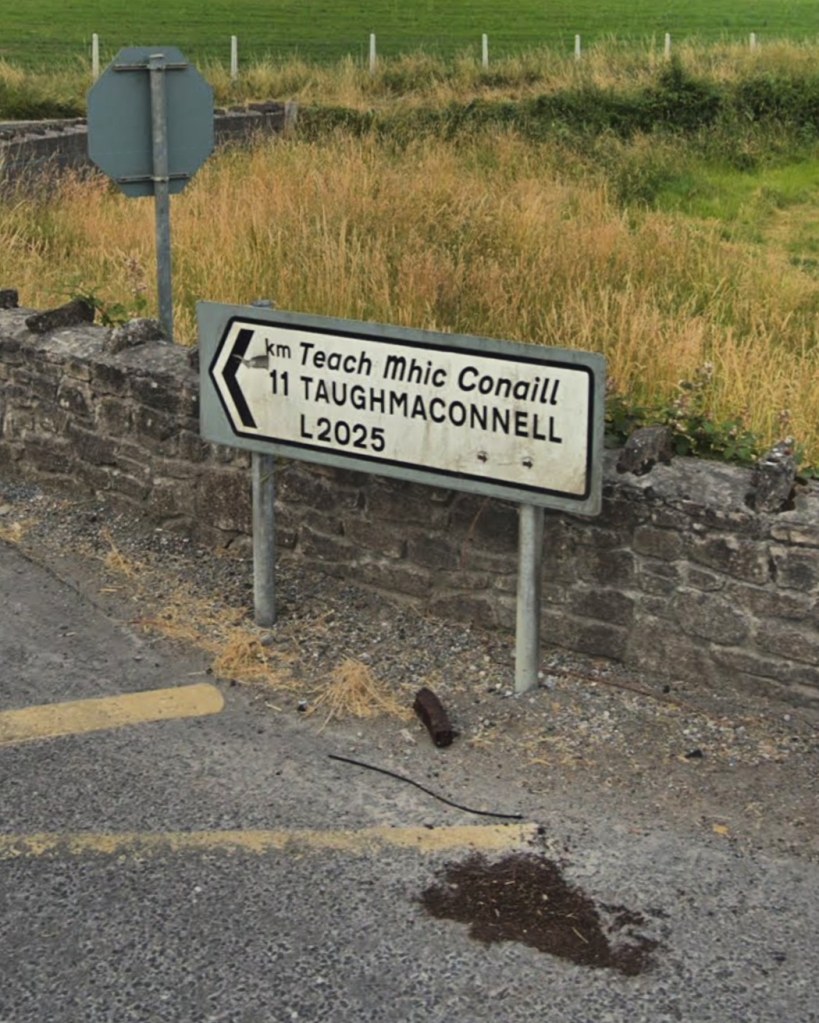
Teach Mhic Conaill / Taughmaconnell

Teach Mhic Conaill / Taughmaconnell (also Taghmaconnell) is a smallvillage between Athlone and Ballinasloe in Co. Roscommon

Vocabulary:
teach = house
mac = son
Conall = Connell (Irish name)
Mac Conaill (literally: son of Conall) = MacConnell (Irish surname)
teach Mhic Conaill = a house of MacConnell

Grammar:
An Irish male’s surname generally consists of “Mac” (son) or “Ó/Ua” (descendant, grandson) followed by a name in genitive.

Conall > Mac Conaill / Ó Conaill
Dónall > Mac Dónaill / Ó Dónaill
Uigeann > Mac Uiginn / Ó hUiginn

#roadsigns #roadsign #road #sign #ireland #eire #irish #irishlanguage #gaeilge #anghaeilge #learnirishfromroadsigns #foghlaimgaeilgeochomharthaibothair

Eastát Tionscail / Industrial Estate

Eastát Tionscail / Industrial Estate

Vocabulary:
eastát = estate
tionscal = industry
eastát tionscail = an estate of an industry

Grammar:
Both words “eastát” and “tionscal” form weak plurals. A weak plural is formed my modification of a noun stem or using a suffix “-a”.

leabhar (book) > leabhair (books)
cluas (ear) > cluasa (ears)

Very often the nouns with weak plurals have nominative singular = genitive plural and nominative plural = genitive singular.

eastát = an estate = of estates
eastáit = of an estate = estates

tionscal = an industry = of industries
tionscail = of an industry = industries

#roadsigns #roadsign #road #sign #ireland #eire #irish #irishlanguage #gaeilge #anghaeilge #learnirishfromroadsigns #foghlaimgaeilgeochomharthaibothair